
Beyond the symbol
What yin and yang really offer your wellbeing
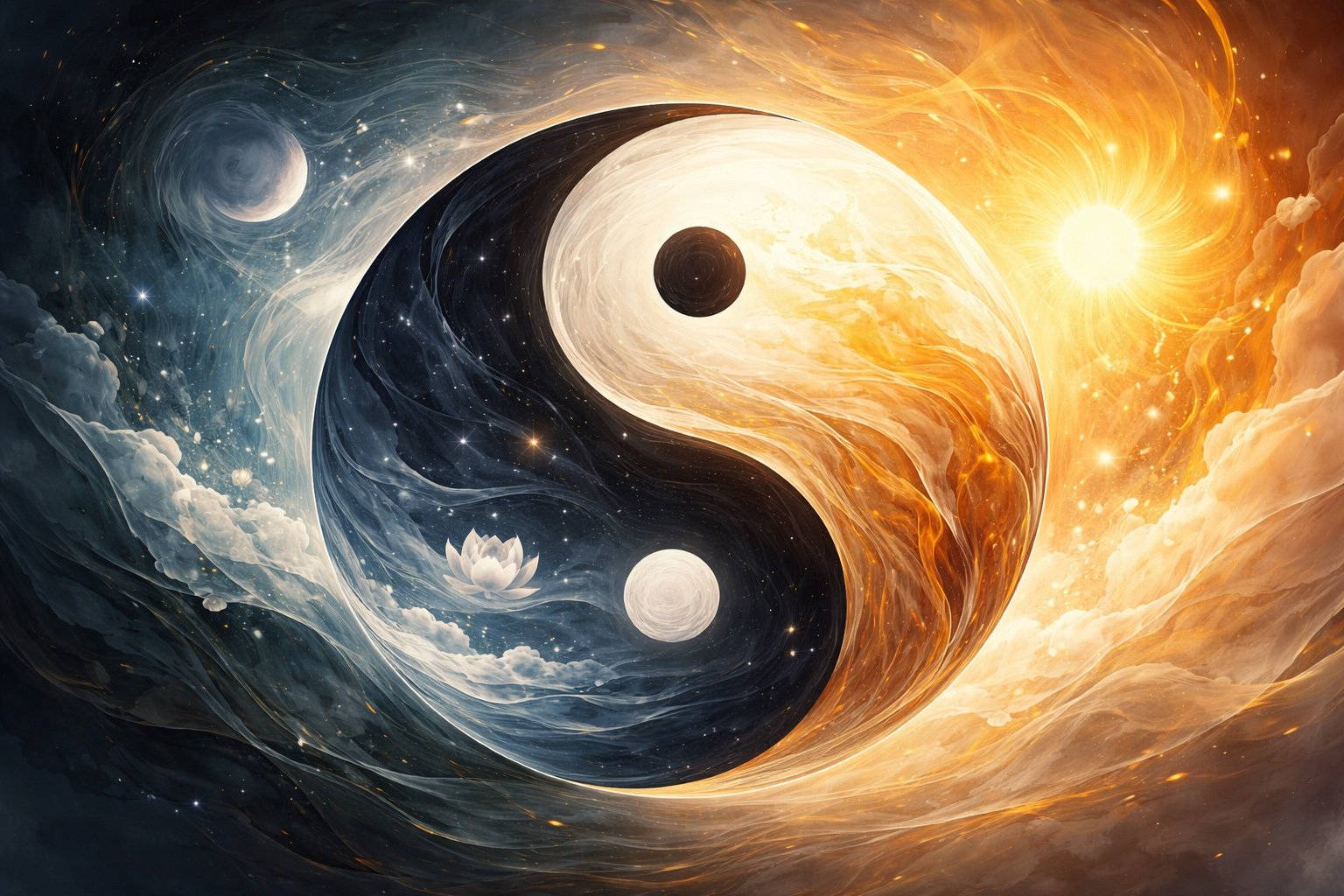
You've seen the symbol. The black and white swirl, each side containing a dot of the other, endlessly turning. It's on yoga studio walls, jewellery, tattoos. It's become so ubiquitous that it's easy to think we understand it. But beyond the familiar symbol, the deeper meaning of yin and yang offers a powerful way of understanding balance, wellbeing, and how we move through life.
After years of teaching Qigong, I have noticed that most people understand yin and yang in very superficial ways. Masculine and feminine. Light and dark. Good and bad. And while some of these associations have their place, they miss something essential about what this ancient concept can actually offer us.
What Yin and Yang Really Means
At its heart, yin and yang is a way of describing natural relationships and continuous change. The original meaning of yin and yang is both simpler and more profound than the gendered interpretations we often encounter. The Chinese characters literally describe the shady side and the sunny side of a hill.
Imagine standing on a hillside. One side is bathed in sunlight, warm, bright, active. The other rests in shadow, cool, quiet, still. But here is what matters. It is the same hill. The light and shadow are not separate entities fighting for dominance. They are different aspects of one complete landscape, constantly shifting as the sun moves across the sky.
This is the essence of yin and yang. Not opposition, but wholeness. Not contradiction, but complementary forces that create balance through their relationship with each other.
Yin and Yang as a Way of Understanding Life
Rather than being a belief system, yin and yang is a way of seeing how life functions. Yin and yang theory is based on the idea of two polar complements. They are labels we use to describe how things function in relation to each other and to the universe, a framework for understanding the continuous process of natural change.
More than that, yin and yang represent a way of thinking. Everything is seen as part of a whole. Nothing exists in isolation and there are no absolutes.
All things have two aspects, a yin aspect and a yang aspect, and these aspects are always relative to everything else. Take the body, for example. The front of the body is considered more yin, the back more yang. The upper body is more yang, the lower body more yin. These are not fixed categories, they are relationships.
Sometimes yin and yang in the body are described as the body’s water and fire. Water is cooling, descending, nourishing, yin qualities. Fire is warming, rising, activating, yang qualities. Both are essential. You need both to be whole.
This is what makes yin and yang different from simple dualism. It is not about one being better than the other. It is about recognising that they define each other, create each other, and transform into each other in an endless dance.
Yin and Yang in the Body
Yin and yang are not abstract. They are something we can feel directly in the body.
When I teach about yin and yang, the biggest shift I see is not intellectual, it is personal. Students suddenly realise they are not separate from these cycles. They are in them.
This changes everything.
When you understand that periods of rest, slowness, heaviness, and introspection are natural yin phases, not personal failures, you can stop blaming yourself. When you recognise that high energy, activity, brightness, and outward focus are yang phases that naturally rise and fall, not a constant standard you are failing to meet, you can breathe a little easier.
It is not about you being broken. It is about recognising the rhythm you are already moving through.
I will be honest. This is a lesson I am still learning. Even now, in mid-winter, it would be easy to get swept up in the energy of the new year. The pressure to set ambitious goals, to do more, to be more. But the reality is that winter is a deeply yin time. My body wants to sleep longer in the mornings. My energy is quieter. And perhaps that is exactly as it should be.
Everything is a choice, and I cannot do everything. Recognising that is not giving up. It is working with the natural rhythm rather than fighting against it.
From Self Blame to Self Compassion
This is where the yin and yang framework becomes deeply practical for wellbeing.
When you are going through a hard time, burnout, grief, perimenopause, exhaustion from decades of caring for everyone else, it is incredibly easy to make it personal. To think you are not trying hard enough, not resilient enough, not managing well enough.
The yin and yang framework offers a different lens. It does not make the difficulty disappear, but it reframes it. You are not failing. You are in a yin phase. It is hard, yes. You might not like it. But it is part of a larger process, a natural cycle.
And here is the part that gives me hope. Within yin, there is always yang. Within yang, there is always yin. Those small dots in the symbol are not decorative, they are essential. They remind us that even in the depths of winter, there are glimmers of spring. Even in the height of summer’s activity, there are moments of rest.
When I am really struggling, what helps me most is remembering this. Practising noticing where the small seeds of change might already be present, even if I cannot see the full shift yet.
And it is not just personal. The way yin and yang show up in our lives is influenced by the wider culture we are moving through.
Yin and Yang in an Unsettled World
We live in a time of constant stimulation. News cycles move at speed. Social media demands instant reactions. There is pressure to have an opinion, to respond, to act now.
From a yin and yang perspective, this reflects an imbalance toward constant yang. Outward focus, urgency, activity, intensity.
Yin and yang does not tell us to disengage from the world. But it does offer discernment.
It reminds us that not every moment calls for action. Sometimes the most appropriate response is yin, pausing, listening, absorbing, letting things settle before responding. At other times, yang is needed. Clear boundaries, decisive action, speaking out, movement.
The problem is not action itself. It is action without rest. Engagement without reflection. Yang without yin.
Yin and yang asks different questions:
Is this a moment to step forward, or to step back?
What is being asked of me here, activity or receptivity?
Am I responding from pressure, or from clarity?
When we stay connected to these rhythms, our involvement in the world becomes more sustainable. We do not burn out as quickly. We do not numb ourselves or collapse into overwhelm. We learn when to engage deeply, and when to restore ourselves so that our engagement can be meaningful.
In this way, yin and yang is not passive. It is intelligent. It is responsive. And it helps us stay human in times that can feel anything but.
The Permission to Be Yin
Many of us, particularly as we reach middle age and life becomes fuller and more demanding, have spent decades operating primarily in yang energy. Doing, achieving, producing, caring for others, being on all the time. We have been conditioned to equate our worth with productivity, brightness, and constant availability.
Yin and yang offers radical permission. It is not just okay to be slow, heavy, and restful, it is necessary. You cannot have yang without yin. Rest is what makes action meaningful. Shadow is what gives light definition.
This can be frustrating. I fall foul of this all the time. The conditioning to always be productive, to always be up, is strong. But sometimes it is okay not to be on. We all need a reboot, not because we are machines that have broken down, but because we are natural beings moving through natural cycles.
The qualities we often try to avoid, slowness, heaviness, darkness, inward focus, are not weaknesses. They are necessary phases of regeneration. They are where the seeds are planted that eventually grow into new yang activity.
Finding Balance: The Dance, Not the Destination
One of the biggest misunderstandings about yin and yang is the idea that balance means equal parts. Balance is dynamic and constantly shifting. Think of the seasons. Winter is not bad because it is more yin, and summer is not good because it is more yang. Each has its place, its gifts, and its necessary role in the larger cycle.
The same is true for us. Some days and some seasons of life will be more yin. Others will be more yang. The practice is learning to recognise where you are and what you need, rather than fighting to be somewhere else.
This is about working with natural rhythms, not against them.
Experiencing Yin and Yang Through Practice
Understanding yin and yang intellectually is one thing. Experiencing it in your body is another.
One of the moments I see students really grasp this is in their standing practice. When they root their energy downward, heavy, stable, grounded, yin, while simultaneously reaching the crown of the head upward toward the sky, light, expansive, lifted, yang, they are embodying both forces at once. They become the hillside holding both shadow and light.
You can feel this now. Stand for a moment. Let your feet feel heavy on the ground, your weight sinking downward through your legs. At the same time, imagine a gentle thread lifting the crown of your head toward the ceiling. Down and up. Rooted and lifted. Yin and yang.
Or try this with your breath. Notice how the inhale is yang, active, expanding, bringing energy in. The exhale is yin, releasing, softening, letting go. You do not need to force anything. The breath already knows this dance. You are simply paying attention to what is already happening.
These are not complicated practices. They are ways of tuning into the rhythms already present in your body, already moving through you.
The Wholeness of It All
What I keep coming back to is this. Yin and yang is not about splitting life into categories. It is about recognising wholeness. The way rest and action need each other. The way darkness makes light visible. The way challenging times contain seeds of growth, and joyful times contain seeds of change.
It is not good and bad. It is not always comfortable. But it is complete.
And perhaps, when we can see ourselves as part of these larger cycles, not separate from them and not fighting them, we can be a little more forgiving with ourselves. Less inclined to take everything personally. More willing to trust that the phase we are in, whatever it is, has its place in the larger pattern.
That is what I am still learning. And that is what I hope understanding yin and yang, really understanding it rather than just recognising the symbol, might offer you too.
If you would like to explore these ideas through lived, embodied practice, you are very welcome to join one of my Qigong classes, where we work with yin and yang not as concepts, but as felt experience.