
5 Ways Qigong Can Ease Stress and Anxiety Naturally
A gentle, natural approach to feeling calmer and more grounded
Sometimes people come to Qigong knowing exactly what they are looking for. Other times, they arrive because they feel overwhelmed, restless, or unable to switch off. There can be a sense of being “on” all the time, without much space to rest. If you’re not sure what Qigong is, you can read more about it here.
Modern life often creates this feeling. There is a quiet pressure to do more, be more, achieve more, and keep up. Over time, it can feel like running on empty, even as we long for a slower pace.
I notice this in myself too. Even after moving to Bournemouth, where life can feel slower and closer to nature, that familiar pull still appears. And yet, when I step away from it, even for a simple walk, something begins to soften.
Qigong offers a gentle, natural way to support stress and anxiety through the body. These experiences are often understood through the Five Elements, particularly Fire and Earth.
Here are five ways Qigong can help ease stress and anxiety, and why the practice works in a sustainable and grounded way.
1. Qigong Settles Excess Fire
In Qigong, Fire is associated with warmth, joy, connection, and a sense of aliveness. When balanced, it is like a steady flame that brings light and vitality without overwhelming the system.
Modern life often keeps that flame constantly fed. Even the things we enjoy can begin to take on that quality. Rest becomes something to improve, and connection becomes something to keep up with, leaving little space for things to settle.
In Qigong, this is understood as excess Fire. The system is activated, the mind is busy, and it can feel as though the body has forgotten where the off switch is.
This is not something to fix, but a pattern the body has learned. Qigong gently creates the conditions for that Fire to settle. The movements are slow, steady, and repetitive, with no sense of urgency or performance. Instead of adding stimulation, the practice reduces it, guiding attention away from the busy mind and back into the body.
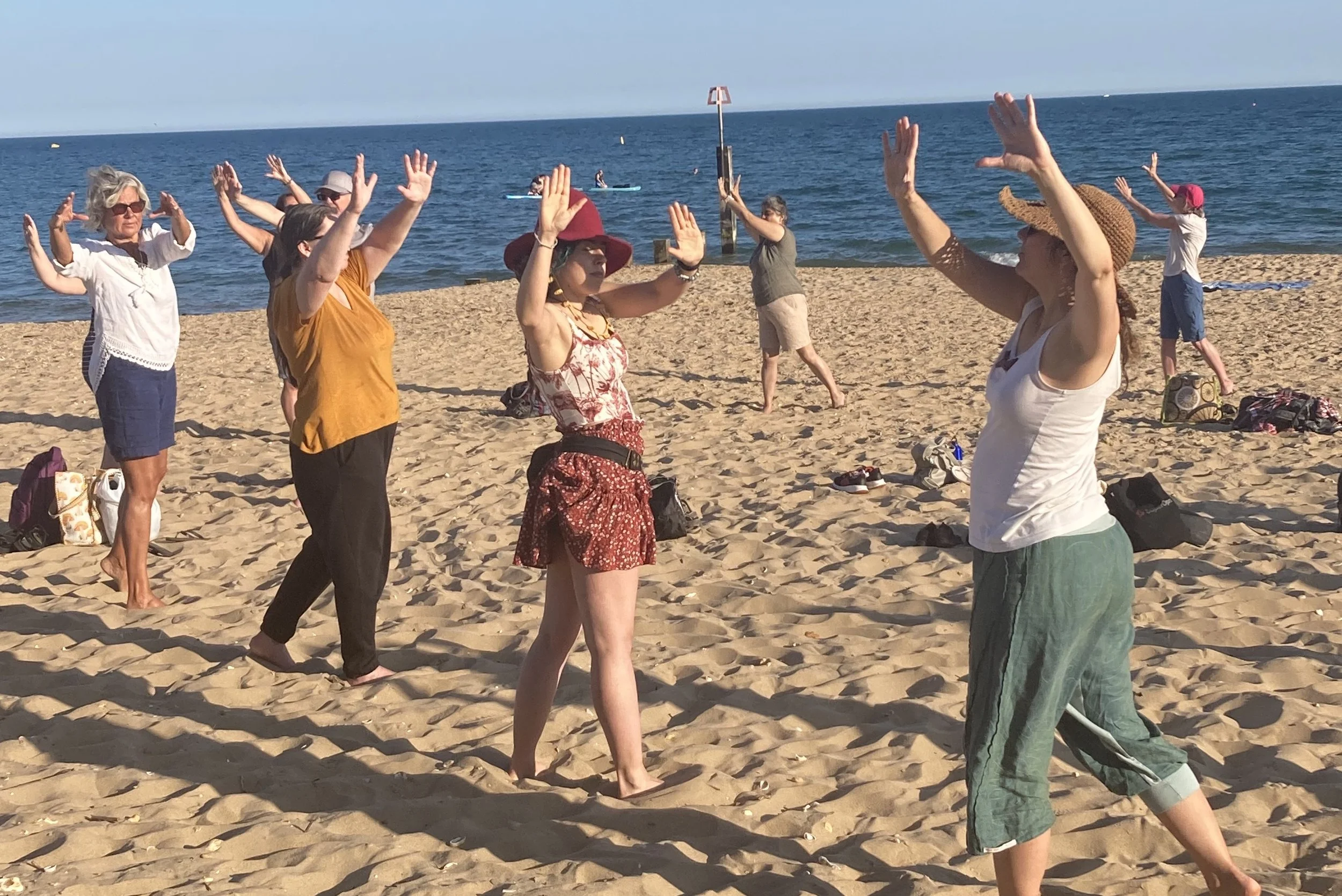
In my classes, we begin simply by arriving: standing, noticing the body, and allowing the breath to be as it is. Often within minutes, there is a visible shift: shoulders soften, the jaw releases, and the breath deepens. It is as if the flame begins to steady itself.
Over time, many people find it becomes easier to rest and to sleep, as the system learns it does not need to stay switched on all the time. Rather than putting the Fire out, Qigong helps it return to something more sustainable, like warmth that can be carried, rather than heat that consumes.
2. Qigong Supports Natural Breathing
In Qigong, the breath is not something we try to control or perfect. Instead, we create the conditions for it to return to a more natural rhythm.
When we are stressed or anxious, the breath often becomes shallow or held, sometimes without us noticing. This is simply the body responding to a state of activation.
In practice, we begin by noticing the breath as it is, without trying to change it. Hands might rest gently on the lower abdomen, bringing awareness to the body.
As the movements slow and the body begins to settle, the breath often shifts on its own. It deepens slightly, softens, and moves more easily through the body. We do not need to force it, and often there is a sense of relief in that.
Over time, this supports the more restful and receptive qualities of the system, helping the body recognise that it is safe to soften.
3. Qigong Brings You Back to Centre and Settles Earth
In Qigong, Earth is associated with centre, stability, and nourishment. When it is in balance, it helps us feel steady, able to return to ourselves, and able to think clearly.
When Earth becomes excessive, the mind can become very active, moving in loops that are hard to step out of. Thoughts can circle without resolution, especially at night.
Like rich soil, Earth supports growth, but when there is too much, things can feel heavy and stuck.
Qigong works with this by bringing attention down into the body and into the simple support beneath us. You might begin to notice the ground under your feet and the weight of the body being held.
As attention moves downward, there can be a sense of returning to centre—away from the head and back into the body. The mind often begins to quiet, not because it has been forced to stop, but because it no longer needs to work so hard.
4. Qigong Restores Flow
In Qigong, when energy flows, we tend to feel more at ease. When it becomes stuck, we can feel tense, irritable, or disconnected from ourselves.
Stress and anxiety often create this sense of holding. The body tightens, the breath becomes restricted, and areas such as the shoulders, chest, or jaw can carry more tension than we realise.
Over time, this can begin to feel normal.
Qigong works gently with this, using slow and repetitive movements to invite things to move again. Softening and mobilising around the joint spaces to enable a feeling of softness and fluidity.
At first, repetition can feel unfamiliar, especially if you are used to being busy or easily distracted, or if part of you is already wondering what is coming next.
But if you stay with a simple movement for a little while, something begins to shift.
The movement becomes rhythmic, the body softens, and the breath finds its own pace.
There is something deeply natural about this rhythm. You can see it in the movement of water, in the breath, and in the cycles of day and night.
As the practice continues, areas of holding can begin to release, not through force, but through gentle and repeated invitation.
Many people notice that after a few minutes they feel more spacious and more present, as if something that was stuck has begun to move.
5. Qigong Helps Release Stored Tension
Stress and anxiety are often held in the body as well as the mind.
You might notice this in the shoulders, the jaw, the chest, or the belly. Over time, this holding can become so familiar that it is barely noticeable.
In Qigong, we explore a quality of softening without collapsing. The body remains upright and supported, but without unnecessary effort.
This begins with awareness, noticing where there may be holding or protecting, and gently inviting a little more ease. Sometimes that holding has been there for a long time, for good reason, and it does not always let go immediately.
Qigong does not force anything to change. It offers the possibility of softening, a little at a time reflecting the cycles of the seasons. Much like the seasons, there is a time for everything.
Over time, many people notice a growing sense of lightness and space in the body.
The Bottom Line: Creating the Conditions for Balance
Qigong gently supports the body to return to its natural harmony.
It helps to settle excess Fire so the system does not feel constantly switched on. It supports the breath to return to a natural rhythm, encourages the body to release holding, and reconnects you with the ground beneath you. It also restores a sense of flow where things may have felt stuck.
You do not need to be flexible or experienced to begin, and you do not need to feel calm before you start. You simply begin where you are, including on the days when that feels easier and the days when it does not. With regular practice, many people begin to notice more space in the body, a quieter mind, an easier relationship with rest, and a greater sense of presence. Qigong is not a replacement for professional mental health support, but regular practice can help regulate the nervous system and support you in working with anxiety as part of a broader approach.
Over time, these changes build in a way that feels steady and sustainable.
If you’re curious to join a class, and are local to Bournemouth or Christchurch, you’re welcome to join me.