
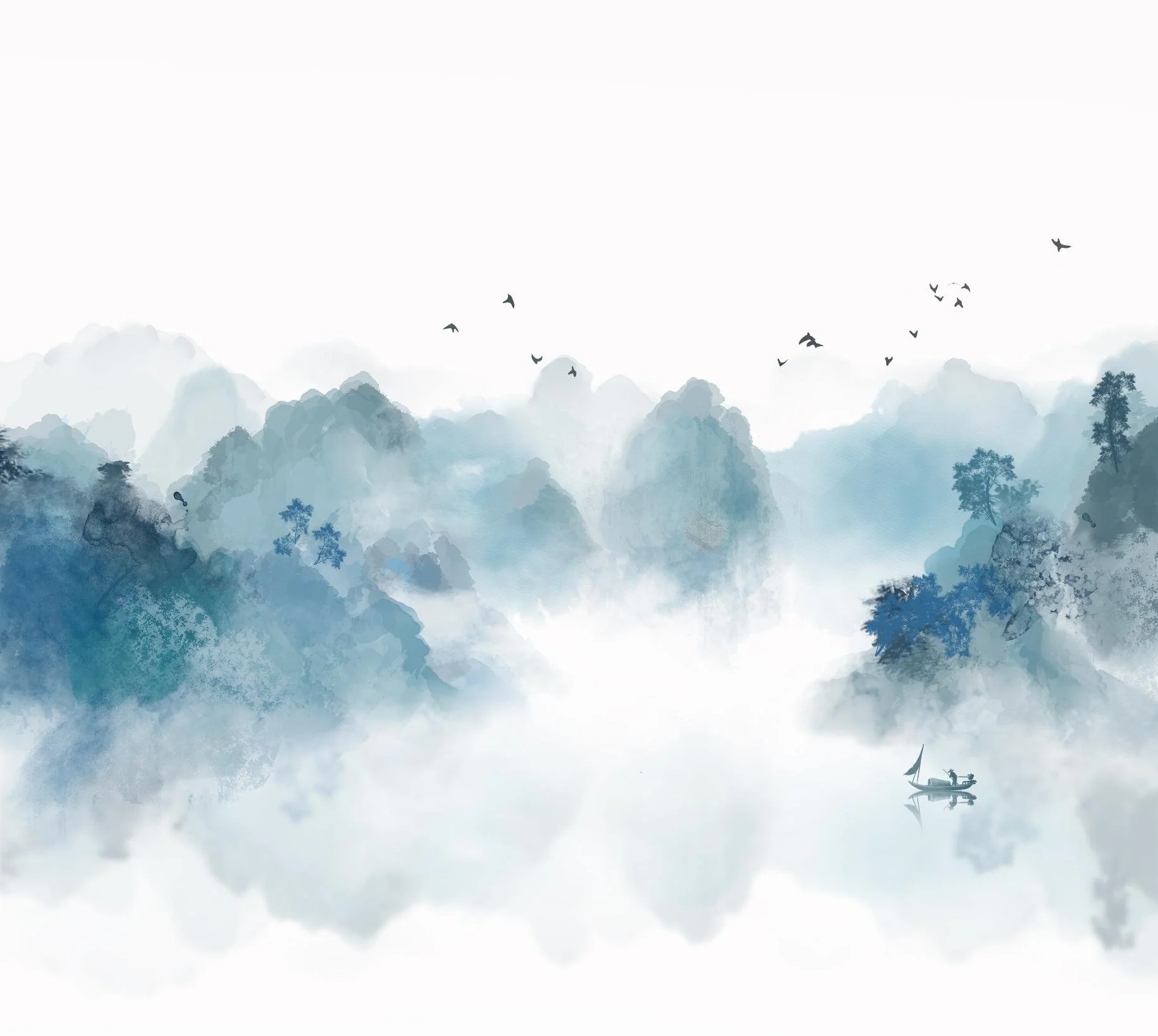
The Body as Landscape
When the body is not a structure, but a landscape of attention
If you were asked to draw your body, what would you draw?
Most of us would begin with an outline. A familiar shape learned at school: skin, bones, organs, perhaps muscles. We have inherited a particular map of the body, one that has taught us to see it primarily as a physical structure.
different maps of the body
Yet across cultures and traditions, people have drawn very different maps to understand the body.
A yogi might draw centres of energy connected by subtle channels. An Ayurvedic practitioner might describe layers of experience: body, breath, mind, wisdom, and joy. An acupuncturist might draw rivers flowing through the landscape of the body, with wells, springs, reservoirs, and confluences where energy gathers, disperses, or changes course.
Each map reveals something. Each invites a different relationship with ourselves.
Perhaps this is why I have always been fascinated by the ways people imagine and understand the body. Not because one map is right and another is wrong, but because each asks us to pay attention to different aspects of our experience.
The Body as Landscape
What if the body is not only a structure to be managed, but a landscape to be inhabited?
A landscape has weather. It has seasons. It contains places that feel fertile and places that feel dry. There are paths we know well and paths we have forgotten. There are rivers that flow freely and rivers that have become blocked. There are mountains that give perspective and valleys that ask us to slow down.
When we think of the body in this way, the question changes. We stop asking only, "What is wrong?" or "How can I fix this?" We begin to ask, "Where am I?" and "What is this place asking of me?"
And perhaps that is why these older maps continue to resonate. Not because they offer perfect descriptions of anatomy, but because they offer something many of us are quietly seeking: a way to orient ourselves. A way to find our way back to ourselves.
Inner and Outer Landscapes
In many traditions, the boundary between body and landscape becomes surprisingly porous. Rivers, mountains, forests, breath, weather, and awareness are not understood as separate phenomena but as expressions of the same living world.
I think of my grandmother chanting praises to the earth. In those verses, the land itself became a body: garlanded with rivers, draped with forests, adorned with mountains rising like breasts. The earth was not scenery. It was alive, sacred, and intimately connected to human life.
The Chandogya Upanishad offers a similar sensibility, inviting us to recognise correspondences between the inner world and the outer world. The landscapes around us become mirrors for the landscapes within us.
when attention becomes fragmented
Yet many of us spend much of our lives moving quickly from one demand to the next. We learn to organise, manage, and respond. Our attention becomes fragmented. We can begin to feel disconnected from the quieter signals of the body, from creativity, from the simple pleasure of noticing. It is not that the landscape disappears. Rather, we stop visiting parts of it. Some paths become overgrown through lack of use. Some rivers are no longer heard beneath the noise.
Perhaps this is one reason so many people speak of wanting to feel more like themselves again. Not to become someone new, but to rediscover a relationship with parts of themselves that have been waiting patiently in the background.
Creativity, nature and attention
Perhaps this is why nature so often appears when people speak about joy. In recent conversations with participants, I have heard stories of walking by the sea, tending gardens, making things with their hands, watching birds, laughing with friends, losing track of time in creative work. These moments are rarely described as achievements. Instead, they feel like moments of connection.
And perhaps that connection is what many of us miss.
Not creativity itself, but the quality of attention that creativity requires. The ability to notice. To imagine. To play. To be moved by something.
Research in arts and health increasingly suggests that these experiences matter deeply for our wellbeing. Yet long before the studies, people knew this through lived experience. They knew that singing, making, dancing, storytelling, movement, and time in nature helped them feel more fully alive.
Perhaps these activities are not additions to life at all. Perhaps they are ways of remembering the landscape we already inhabit.
Shanshui: Landscape in motion
In Chinese landscape painting, the tradition of shanshui, literally "mountain water", artists did not simply depict scenery. They painted the movement of qi: the vital energy understood to flow through mountains, through rivers, through mist, through the brushstroke itself, and through the body of the person standing before the painting.
When I first encountered qigong, I recognised something I had been circling around for years. Through yoga, shiatsu, and other traditions that spoke of emotions, energy, and the body as a living landscape, I had already been drawn to ways of understanding the body that went beyond muscles and bones. The idea that there might be patterns, rhythms, and currents moving through us felt less like discovering something new and more like recognising something that had always been there.
This was one of the things that first drew me to qigong. Qi gong means something like the cultivation of this same energy. When we move slowly, breathe with attention, or stand quietly and feel the body settle into the ground, we are not performing exercises. We are participating in the same flow that moves through mountains, rivers and mist.
Standing quietly, we might notice the weight of our feet meeting the earth. The movement of breath beneath the ribs. A subtle feeling of expansion on an in-breath and softening on an out-breath. These are small experiences, easy to overlook. Yet they can become landmarks. Ways of recognising where we are and how we are. Ways of returning to the landscape of our own experience.
The body, in this view, is not separate from the landscape. It is made of the same substance, subject to the same principles. Qi rises and falls, gathers and disperses, finds its way around obstruction the way water finds its way around stone.
qigong and the practice of attention
Perhaps this is why practices such as qigong, time in nature, creative work, and encounters with art can feel unexpectedly nourishing. They invite us into a different quality of attention. They ask us to slow down enough to notice what is already here.
A painting invites us to linger with colour, form, texture, and space. The longer we look, the more we begin to notice. A landscape invites us to notice changing weather, shifting light, and the movement of water. Qigong invites us to notice the same qualities within ourselves. Each begins with attention.
We do not need to master the landscape. We do not need to fix it. We begin by inhabiting it more fully.
Perhaps the practice is not about becoming someone else. Perhaps it is about remembering where we are.
And perhaps, in that remembering, we find our way back to the rivers, mountains, weather, and wildness that have been there all along.
a note on this work in practice
This is one of the ideas I'll be exploring in What Beauty Moves, a series of movement and reflection sessions inspired by landscape, art, and the practice of paying attention, at the Russell-Cotes Art Gallery & Museum this September.