
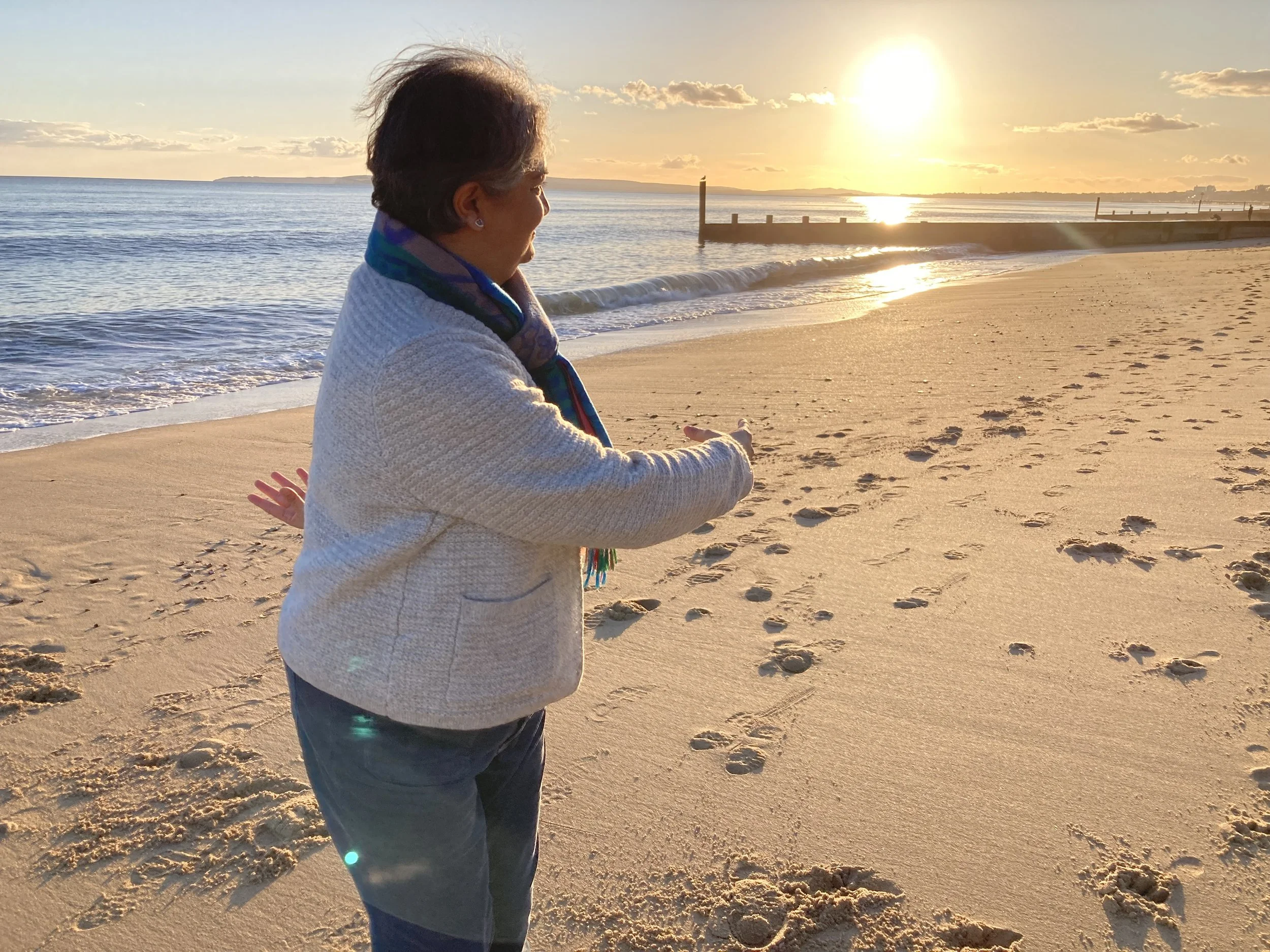
Where Does Your Energy Go?
qigong and the three treasures
Have you noticed recently how often you are asked to optimise yourself? I find this exhausting. We are surrounded by advice on how to optimise our sleep, improve our focus, regulate our nervous system, take the right vitamins and maximise our training. The compassionate act of looking after ourselves can begin to feel like a full-time job, with habits to track and targets to hit.
The irony isn't lost on me that I'm writing an article about all this, and am about to offer you some thoughts on what you might do differently. Apparently, I can't resist adding to the conversation either. As a Qigong teacher, I spend a good part of my week watching where people’s energy goes, mine very much included. So, I'll try not to give you another list of things to optimise.
A couple of years ago, the battery in my watch gave up. It was a small, dressy watch, not really suitable for teaching in, so I bought myself a cheap replacement for everyday use. It's large enough for me to tell the time at a glance, which is useful when I'm teaching. It looks rather fancy, a bit like one of those watches that tracks everything, but it does nothing other than tell the time and beep when the alarm is set.
I've never felt the need for a digital device to tell me whether I've slept, how many steps I've taken or who knows what else I could count. I am not interested in measuring myself or maxing out. I can pay attention and figure some things out for myself.
One thing I have noticed, though, is that I don't have the energy I once had. At first, I wondered how I might boost it. Then I began to think that perhaps the answer wasn't to squeeze more energy out of myself, but to understand the energy I have.
The current enthusiasm for “sleep hacks”, with its sleep trackers, elaborate bedtime routines and viral sleep hacks, is one example of how easily looking after ourselves can become another thing to get right. Of course, sleep matters, and some changes to our habits can make a real difference. But I'm interested in what happens when the search for better health starts to feel like another performance.
Where does our energy actually go?
Not all of us have the same amount of energy to begin with. Our age, health, circumstances, caring responsibilities and the demands of everyday life all play a part. Some of us have more room to change our routines than others. And even when we do have choices, it isn't always easy to recognise what leaves us depleted until we find ourselves running on empty.
I'm interested in how we might become more attentive to our energy: what uses it up, what replenishes it, and what helps us feel more present and alive. This is something I explore through my Qigong practice, where attention to the body, breath and sensation offers a different way of approaching the question.
Perhaps the answer isn't always to do more, or even to find a better way of doing everything. Perhaps it begins with learning to notice.
Jing, Qi and Shen in plain English: Three ways of thinking about energy
In Qigong and Chinese traditions, the Three Treasures are Jing, Qi and Shen: Essence, vitality and spirit and they are a way of understanding how our energy sustains us. Think of Jing as the deep reserves you build and store, Qi as the energy that carries you through the day, and Shen as the clarity and presence that lets you notice both. The words don’t translate neatly into English, and their meanings are richer than any simple definition can convey..
I find it useful to approach these ideas through everyday experience, without pretending that a traditional concept can be reduced to a modern self-help technique. I find myself returning to three practical questions: where does my energy leak away, what helps replenish it, and how might I preserve what I have?
1. Noticing the leaks
Sometimes the things that use up our energy are obvious: a demanding day at work, a difficult conversation, a poor night's sleep, or the effort of caring for someone else. At other times, the drain is less noticeable. We rush from one thing to another, keep too many things in mind, respond to every message as it arrives, or say yes before checking whether we have the capacity.
There are also the things we cannot simply stop doing. We may have responsibilities that are non-negotiable, health conditions that affect our energy, or circumstances that leave us very little room to rest. This isn't about blaming ourselves for being tired, or imagining that a few better habits can solve everything.
It is about becoming curious.
What do you notice after a day of constant switching between tasks? How do you feel after spending time with certain people, or after being outdoors? Which activities leave you tired in a satisfying way, and which leave you feeling scattered or empty?
We don't need to measure every detail. Sometimes it is enough to pause at the end of the day and ask, What took more out of me than I expected?
In Qigong, attention is part of the practice. We notice what is happening rather than immediately trying to correct it. We might become aware of a clenched jaw, a held breath, shoulders creeping upwards, or the feeling of hurrying even when there is no immediate need to. These small signals don't tell us everything, but they can help us recognise when we are using effort without quite realising it.
2. Finding what replenishes us
When we feel depleted, the instinct is often to look for a big solution: a new routine, a holiday, a fresh start. Sometimes we genuinely need a substantial change or proper rest. But replenishment can also happen in small, ordinary ways.
It might be a few minutes outside, a proper lunch eaten sitting down, a conversation in which we don't have to perform, or a little time without an incoming stream of information. It might be listening to music, making something with our hands, or doing something simply because it gives us pleasure.
For me, Qigong offers a way of returning to the body without demanding that it achieve anything in particular. The movements can be slow and simple. We pay attention to our breathing, the shifting of our weight, the feeling of our feet on the ground, the movement of the arms through space. We begin to notice the relationship between effort and ease.
This isn't about forcing ourselves to relax, either. Some days, standing still feels uncomfortable; some days, movement is more helpful than quiet. The invitation is to discover what is appropriate now, rather than follow a prescribed routine regardless of how we feel.
You could try this for yourself. Take a moment to feel your feet on the floor. Let your knees soften if that is comfortable, and notice your breathing without trying to change it. Allow three easy breaths to come and go. You don't have to make anything happen. Simply notice how you are arriving at this moment.
It may not transform your day, and it doesn't need to. The point is to create a little space in which you can listen.
3. Learning to preserve our energy
This is perhaps the hardest part, because it asks us to recognise that our energy is not limitless.
We live in a culture that tends to celebrate expansion: doing more, achieving more, keeping up, making the most of every opportunity. Rest can easily become something we earn after the work is done. But there is always more to do, and the work is rarely ever completely done.
Nature offers another perspective. Trees don't keep producing leaves and reaching upwards throughout the year. Growth has its seasons. Energy that is visible above ground depends on processes happening elsewhere, and periods of apparent stillness are part of a much longer cycle.
We humans don't have the same freedom to follow the seasons. Our responsibilities continue, and the demands of life don't conveniently pause when we need them to. Still, we might ask ourselves whether every part of life needs to be a period of growth, activity and expansion.
What might it mean to do a little less, or to do something at a more humane pace? Could we leave some space in the diary rather than fill every available moment? Could we let a message wait, stop when we have done enough, or choose not to take on something new?
Preserving energy doesn't mean withdrawing from life. It means recognising what matters to us and making room for it. It might mean saving our attention for the people and activities we care about, rather than allowing every demand to have equal claim on us.
And it means acknowledging our limits without treating them as a personal failure.
An older kind of wisdom
There is another strand of Daoist thought that I find helpful here. In Chapter 67 of the Daodejing also spelled Tao Te Ching), three qualities are named as treasures: compassion, frugality and not presuming to be first in the world, which is often understood as humility.
These are not the same as Jing, Qi and Shen, but they offer a different way of thinking about how we live.
Compassion invites us to meet ourselves with kindness. Instead of treating tiredness as weakness, we can ask what might be needed. We can extend the same understanding to other people, whose circumstances and capacities may be very different from our own.
Frugality suggests knowing what is enough. It is not simply about having less, but about using what we have with care. We can be discerning with our time, attention and energy, rather than scattering them in every direction.
Humility reminds us that we don't have to be first. We don't have to keep up with every trend, become the most productive version of ourselves, or turn every aspect of life into an improvement project. There is a freedom in recognising that we are human, with finite resources and changing needs.
I like the idea that these old teachings might offer a counterweight to our current appetite for optimisation. Rather than asking how we can get more out of ourselves, perhaps we can ask how we might live with greater care for the energy we have.
A question to return to
I'm still learning to pay attention to my own energy. I don't have a formula, and I suspect that what helps changes with our circumstances, our age and the season of life we find ourselves in. What replenishes us one day may not be what we need the next.
But I do find it useful to return to three simple questions:
What drains me? What replenishes me? What do I want to preserve?
You don't need to track your answers or turn them into a new routine. You might simply carry one of the questions with you for a day or two and see what you notice.
Perhaps that is enough for a beginning: not another thing to optimise, but an invitation to pay attention. To recognise the energy we have, to care for it where we can, and to remember that a life well lived is not necessarily a life lived at full capacity.
My watch does nothing but tell the time. Come and spend an hour with me where nothing is tracked, scored or improved. My classes in Bournemouth and Christchurch are unhurried, and the current times are on my classes page.
Not ready for a class yet? Join my newsletter for unhurried, seasonal notes on practice.