
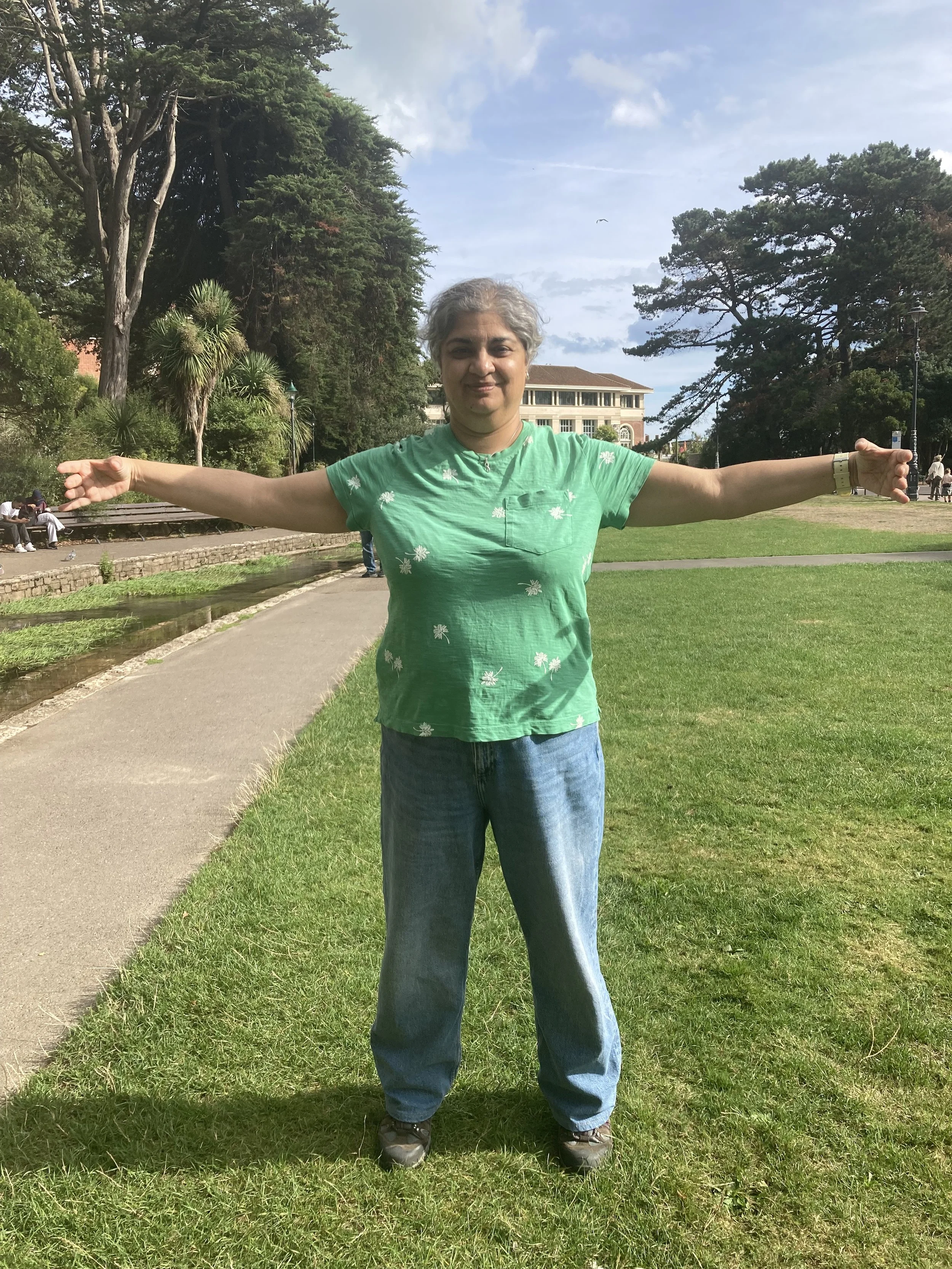
Yi Jin Jing: Strength Without Hardening
Yi Jin Jing, often translated as the Muscle and Tendon Changing Classic, is a traditional Chinese practice of slow, deliberate movement, extension, dynamic tension and pause.
On the surface, it can look like a series of strengthening and stretching exercises. The longer I practise and teach it, the more interested I have become in what happens when strength and softness are cultivated together.
You don't need experience to begin. You don't need to be particularly flexible, or especially strong, or to have a body that already does everything you ask of it. The practice can be adapted, seated or standing, and we work with the body we have today.
What are the benefits of Yi Jin Jing?
Some of the benefits of Yi Jin Jing are relatively easy to describe: strength, mobility, flexibility, balance, coordination and stamina.
There are others that are more experiential: feeling more grounded, noticing tension, sensing the whole body and becoming more aware of breath and movement.
And then there are the qualities that we cultivate through practice: patience, quietness, attention, sensitivity, the ability to stay with something, and learning not to force.
Some of the benefits of Yi Jin Jing are easy to measure. Others are things you notice.
You may become stronger. Your balance may improve. You may find a greater range of movement. But you may also notice when you are holding your breath, gripping your shoulders, rushing a movement or working harder than you need to.
That second kind of noticing is important to me.
My own Qigong, Internal Martial Arts and Neigong practice has changed my understanding of slowness. I don't slow down simply because I enjoy moving slowly. I slow down because I've discovered that some things aren't available at speed.
When I give a movement enough time, I can notice where I am holding, where I am forcing, where something is beginning to change. I have learned to stay with practice long enough to harvest and cultivate what it has to offer.
That is what interests me about Yi Jin Jing: a different way of developing strength, slowly and attentively, without losing our capacity for softness and adaptability.
What does the research say about Yi Jin Jing?
There is increasingly good evidence for the benefits of traditional Chinese exercises, including Yi Jin Jing.
A 2024 systematic review and meta-analysis looked specifically at Yi Jin Jing practice in older adults. It found improvements in functional movements including chair sit-to-stand and squatting-to-standing, as well as some measures of muscle strength. The researchers were appropriately cautious about the quality and consistency of the evidence, so these findings are promising rather than definitive.
I find the functional measures particularly interesting.
Strength isn't only about how much we can lift. It is also about whether we can get up from a chair, rise from the floor, squat, reach, turn and move through ordinary life with confidence.
In August 2026, The Guardian reported on a major umbrella review of traditional Chinese exercises. The review brought together 92 systematic reviews and 1,744 randomised controlled trials, looking at practices including Yi Jin Jing, Tai Chi, Qigong, Baduanjin and Wuqinxi.
Across these traditional Chinese exercises, the researchers found high-certainty evidence for benefits in areas including physical function, pain, mental health, sleep and bone mineral density. The review also suggested that the greatest benefits were associated with sustained, regular practice over time.
It is important to be precise about this: these headline findings apply to the group of traditional Chinese exercises included in the review, rather than demonstrating every individual benefit specifically for Yi Jin Jing.
But I find it significant that Yi Jin Jing is part of such a substantial and growing body of research.
And the emphasis on regular practice resonates with something I already know from the inside: some benefits aren't available to us immediately.
We have to stay with a practice long enough to discover what it has to offer.
Learning to stand: standing meditation
One of the things I value most about Yi Jin Jing and my wider Qigong practice is standing meditation.
We stand every day. We don't necessarily practise standing.
Standing meditation teaches us something quite unusual: how to relax while standing. We remain upright and alert, but allow unnecessary tension to soften.
For me, there is something increasingly relevant about learning this. We live in a world where there is plenty to react to. Can we notice what happens in the body when we are triggered, and find a way back to greater ease without needing everything around us to be calm first?
We can be awake without being braced.
Sometimes there is enormous value in simply standing and noticing.
Strength without hardening
Yi Jin Jing is a strengthening practice. But I don't think strength has to mean hardness.
The practice involves dynamic tension. We extend, engage and hold. There can be real physical effort. Alongside that is an emphasis on relaxation.
Can we be strong without bracing?
Can we work deeply without forcing?
Can we remain responsive while developing strength?
These are physical questions. But I find they have a way of extending beyond the physical, into how we hold responsibility, how we rest, and how we let go of the idea that softening is the same as giving up.
For those of us who have spent years getting things done, this can be quite a radical idea.
The five principles of Yi Jin Jing
Five traditional principles give us a way into the practice: quietness, slowness, extension, pause and flexibility.
They aren't simply instructions for how to perform the movements. For me, they are qualities to explore.
Quietness: Jing
The traditional image is of a calm lake reflecting the moon. When the surface is disturbed, the reflection is distorted.
Quietness here isn't about staying physically still. We can be moving, extending and working while cultivating something quieter internally. For me, this means listening rather than constantly evaluating and correcting.
Slowness: Man
Some things simply aren't available at speed.
I've discovered this increasingly through my own Internal Martial Arts and Neigong practice. When I slow a movement down, I can feel things that disappear when I move quickly: where I am holding, where I am pushing, where my breath changes, where one part of my body begins to influence another.
Slowness isn't doing less. It gives us time to notice more.
And over time, I've learned to stay with practice long enough to harvest and cultivate what it has to offer.
Extension: Shen
There is an important difference between extension and forcing.
Yi Jin Jing asks us to extend through the body, but this doesn't mean pushing ourselves to the furthest point we can reach. For me, the crux of the practice is this: can I reach further while staying relaxed? This changes stretching from something we do to the body into something we explore with it.
Pause: Zhan Ting
The pause is probably the least familiar principle for anyone used to conventional exercise, where we move from one repetition to the next.
Yi Jin Jing asks us to wait. The pause isn't simply a rest between movements. It is part of the practice. Can we stay with an experience without immediately trying to change it? Sometimes a practice's benefits aren't always instant, we have to stay long enough to receive them.
Flexibility: Tanxing
In the practice, flexibility begins physically.
But it isn't simply the ability to reach further. It is also the ability to respond, yield, adapt and recover.
That brings us back to strength without hardening. Perhaps one of the valuable things we can cultivate is the ability to be both strong and flexible.
Where does Yi Jin Jing come from?
Yi Jin Jing is traditionally associated with Bodhidharma, the Indian Buddhist monk linked with the development of Chan Buddhism in China.
According to the well-known Shaolin story, Bodhidharma found the monks physically weakened by long periods of meditation and developed exercises to strengthen them.
It's a compelling story. It's also a disputed history.
The surviving Yi Jin Jing text appears much later than Bodhidharma, and the attribution isn't supported by firm historical evidence. But I still like the idea at the core of the story: the cultivation of mind and the cultivation of body were never meant to be entirely separate.
We meditate, breathe and experience the world in bodies. The body isn't simply a vehicle for the more important activities. It is part of the practice.
Five years, not five weeks
There is a traditional five-year progression associated with Yi Jin Jing, moving through different stages of physical and internal cultivation. I don't take this as a literal physiological timetable, and I don't think we need to.
What I love here is the idea of time itself.
Not five weeks, but five years.
We are so accustomed to programmes with an endpoint: six weeks, twelve weeks, a transformation in 30 days. The traditional five-year perspective offers something very different.
And interestingly, this connects with the recent research too. The large review reported in The Guardian found that the benefits of these practices were associated with sustained, regular practice over time, and that continued practice was important for maintaining improvements.
Perhaps after all, practice doesn't point to a destination.
Practice is the destination.
Give the practice time
We don't need to arrive strong or flexible, and no previous experience of Qigong is necessary. The practice can be adapted for different bodies and levels of mobility, including seated options where appropriate.
What matters more is a willingness to practise, to pay attention and to give things time.
If any of this resonates, Yi Jin Jing is part of what we practise together in my Qigong classes. You're welcome to come and find out what it feels like in your own body. Details of my current classes are here.